



Routines play a powerful role in supporting the growth and emotional well-being of children with Autism Spectrum Disorder (ASD). For many children on the spectrum, the world can feel like a chaotic and unpredictable place. Predictability provides a much-needed anchor, helping them navigate their daily environment with greater confidence and less cognitive strain.
When a routine is consistent and tailored to a child’s individual needs, it creates a foundational sense of structure, safety, and stability. Conversely, a lack of routine can lead to “information overload,” significantly increasing anxiety and making it difficult for children to participate in essential everyday activities such as learning, playing, and interacting with others. For caregivers and parents, establishing a structured routine is not just about scheduling; it is a clinical and emotional tool that can significantly improve a child’s emotional regulation, attention span, and overall participation in family life.
The Science and Benefits of Routines for Children with Autism
 Creating predictable routines is a form of proactive intervention. Many children with ASD have a different way of processing temporal information—knowing “when” something will happen is just as important as knowing “what” will happen. By formalizing the day, parents can provide a roadmap that reduces the “fight or flight” response often triggered by unexpected changes.
The benefits of a well-maintained routine include:
- Reduced Anxiety and Stress: When a child knows exactly what to expect, the fear of the unknown is removed, leading to a calmer baseline.
- Improved Emotional Regulation: Structure helps children manage their internal states. Knowing that a preferred activity is coming up can help them persevere through a more challenging task.
- Support for Independence: Routines allow children to learn the steps of a task (like getting dressed) through repetition, eventually allowing them to perform these tasks without constant verbal prompting.
- Enhanced Understanding of Transitions: Transitioning from a high-interest activity (like iPad time) to a low-interest activity (like bath time) is often a trigger for meltdowns. Routines provide the “warning” needed to shift focus.
- Encouragement of Engagement: When the “logistics” of the day are settled, the child has more mental energy to devote to social engagement and learning.
Every child is unique, and it is vital to remember that a routine should not be a rigid cage. Instead, it should be a flexible framework adapted to the child’s specific preferences, strengths, and sensory profile.
Practical Tips for Implementing Routines at Home
Transitioning from a disorganized day to a structured one requires a step-by-step approach. It is often best to start with one or two key parts of the day—such as the morning or bedtime routine—before attempting to schedule the entire 24-hour cycle. Here are effective, research-backed strategies parents can use to create a supportive home environment.
1. Include a Sensory Diet Plan
Many children with autism experience sensory processing challenges. This means they may be overly sensitive (hypersensitive) or under-responsive (hyposensitive) to sensory input such as touch, sound, light, or movement. If a child’s sensory needs aren’t met, they may become dysregulated, leading to “stimming” or meltdowns.
A sensory diet is a planned, individualized set of sensory activities designed to help children regulate their energy levels and maintain focus throughout the day. It is a “diet” because, much like food, the body needs specific “nutrients” of movement and touch at regular intervals to function at its best. Rather than having one long play session, it is often more effective to intersperse short sensory “snacks” at different points during the day to keep the nervous system balanced.
Physical Activities and Heavy Work
 Physical activities are often the easiest starting point for children who crave movement. These activities utilize large muscle groups and provide “proprioceptive” input—the sense of where one’s body is in space. This type of input is naturally grounding and calming for most children.
- Animal Walks: These are fun, engaging ways to get deep pressure into the joints. Examples include the bear walk (hands and feet), crab walk, frog jumps, bunny hops, or a snake slither.
- Heavy Work: Tasks that involve pushing or pulling can be very centering. This includes wheelbarrow walks, pushing a weighted laundry basket, or pulling a wagon.
- High-Energy Movement: For children with high energy, riding a bicycle or scooter, running, playing catch, or doing jumping jacks can help “burn off” excess physiological arousal.
- Deep Pressure: Bouncing on a large gym ball or receiving “pillow squishes” (gently pressing a pillow over the child while they lie down) provides a calming tactile experience similar to a firm hug.
Tactile Activities for Sensory Exploration
Tactile play helps children explore different textures in a safe environment, which can eventually reduce “tactile defensiveness” (the urge to avoid certain textures like clothing tags or messy food).
- Dry Texture Activities: These are “cleaner” options for children who are hesitant about getting their hands dirty. Use playdough, theraputty, sandboxes, or bins filled with dried beans or uncooked rice. Even drawing with chalk on the sidewalk provides a distinct tactile vibration that many children find satisfying.
- Messy Texture Activities: For children seeking more intense input, messy play is excellent for desensitization. This includes water beads, flour or dough play, mud play, finger painting, foam, slime, and shaving cream play.
Fidget and Fine Motor Activities
For times when the child needs to be still—such as during a meal or while doing homework—small sensory tools can provide the “fidget” outlet they need to maintain focus.
- Stress Balls and Squeezers: These provide hand-strengthening and a calming repetitive motion.
- Fidget Spinners and Tangles: These help occupy the hands so the brain can focus on auditory information.
- Hand Squeezers: These provide a more intense resistive input for children who need stronger sensory feedback.
Auditory Supports
 For children who are hypersensitive to sound, the world can be painfully loud. Routines should include “auditory escapes.”
- Noise-Cancelling Headphones: Essential for trips to the grocery store or loud household moments (like vacuuming).
- Calming Music or White Noise: Using specific playlists for relaxation can signal to the child’s brain that it is time to wind down.
2. Use Visual Supports and Visual Schedules
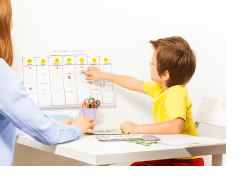 One of the most significant challenges for children with ASD is the processing of verbal language. When a parent says, “Go upstairs, put on your pajamas, and brush your teeth,” the child may only process the first or last part of the instruction. Visual supports bridge this gap.
Many children with ASD process visual information much more efficiently than verbal instructions, especially when they are tired or anxious. A visual schedule is a visual representation of what is going to happen. It transforms the abstract concept of “time” into something concrete that the child can see and touch.
Types of Visual Supports
- Object Schedules: For children who are very young or have significant cognitive delays, using real objects is best. For example, showing a spoon means “it’s time to eat,” and showing a diaper or underwear means “it’s time for a change.”
- Photo Schedules: Using actual photographs of the child’s bed, the family kitchen, or their school bus makes the connection very clear.
- Icon-Based Schedules: Using symbols (like Picture Exchange Communication System or PECS) is great for children who are starting to understand abstract representations.
- Checklists: For older children, a simple written list that they can cross off provides a sense of accomplishment and independence.
Implementing the Schedule
To make a visual schedule effective, it must be used consistently. Place it at the child’s eye level in a central location. When a task is finished, have the child move the picture to a “finished” box or turn the card over. This physical action provides closure to the task and prepares them for the next one.
Creating Routines That Work for Your Child
The ultimate goal of a routine is to improve the quality of life for both the child and the family. However, building a routine is a process of trial and error. Parents should become “detectives,” observing their child’s behavior to see what works.
Ask yourself these questions to refine your approach:
- Does your child prefer movement or quiet activities in the morning? Some children need to jump on a trampoline to “wake up” their nervous system, while others need a soft, slow start with a book.
- Do they respond better to pictures or real objects? If a child ignores a drawing of a toothbrush but responds when you hold the actual brush, stick with the object until they are ready to transition to symbols.
- Which activities help them calm down after a long day at school? School is often sensory-overloading. The “after-school routine” should likely prioritize calming, low-demand activities like a sensory bin or quiet music.
By tailoring routines to your child’s unique neurological profile, you are not just managing behavior—you are providing them with the tools they need to feel safe, understood, and capable.
Key Takeaway: A well-structured routine helps children with autism feel secure, reduces anxiety, and improves their ability to participate in everyday life. Combining sensory activities and visual supports can make routines even more effective, fostering a home environment where the child can truly thrive.